
Existing employees need to evolve with the workplace. Technology is changing the way businesses operate faster than many organizations can redesign their workforce.
Artificial intelligence, automation, cloud platforms, data analytics, digital payment systems, advanced manufacturing technologies and increasingly connected workplaces are changing job roles across industries. The question for businesses is no longer simply “Who should we hire?” It is increasingly “How do we prepare the people we already have?”
This is where upskilling and reskilling have moved from being optional HR initiatives to becoming strategic business priorities.
For Bangladesh, the issue is particularly significant. The country has a large labor force and a rapidly changing economy, but access to continuous workplace learning remains limited. According to the International Labor Organization (ILO), 93.4% of respondents in Bangladesh reported that they had not received any work-based training during the previous 36 months. At the same time, 49.8% of those who had not received training believed they needed training to perform their work better.
This indicates a fundamental challenge: the workforce may be willing and able to adapt, but the systems for continuous learning have not yet caught up with the pace of change.
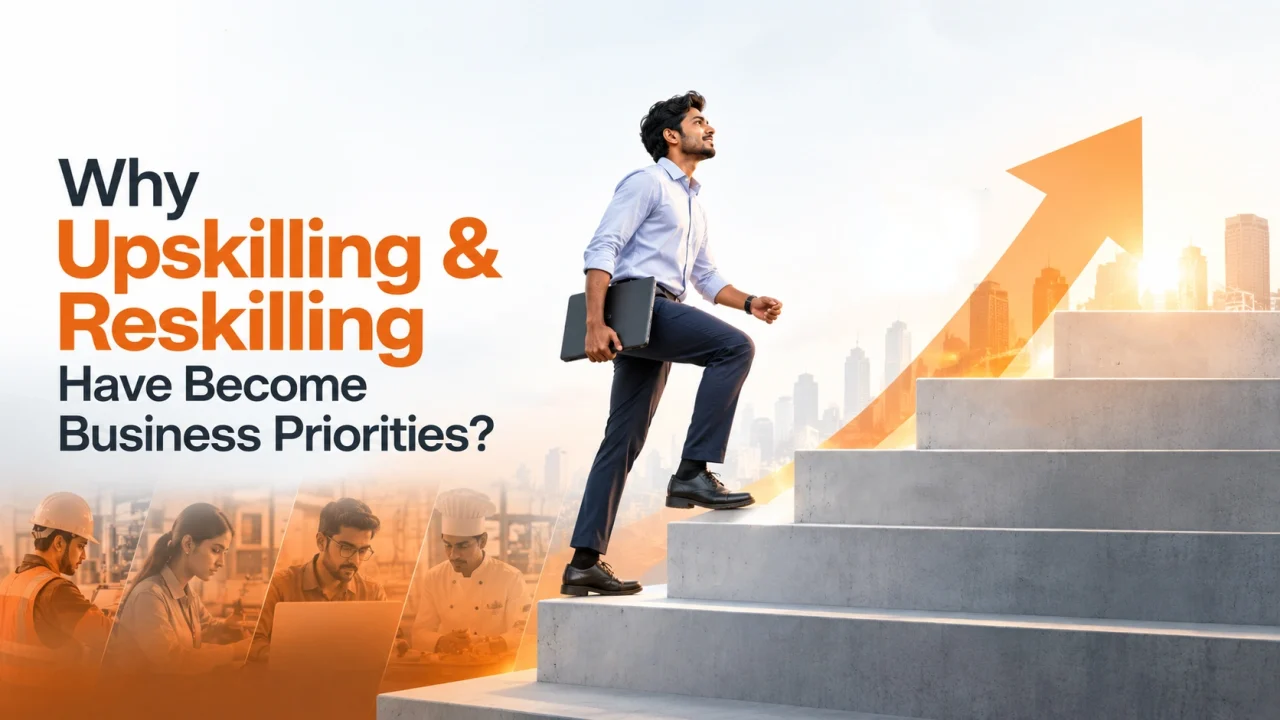
What Do Upskilling and Reskilling Actually Mean?
Although the terms are often used interchangeably, they address different workforce needs.
Upskilling means helping an employee develop additional capabilities that improve performance in their existing role.
For example:
- An accountant learning advanced data analytics and financial software
- An HR professional learning AI-assisted recruitment tools
- A production supervisor learning digital manufacturing systems
- A marketing executive developing skills in analytics, automation and AI-powered content tools
Reskilling, on the other hand, prepares an employee for a substantially different role.
For example, a traditional administrative employee may be trained for a digital operations role, or a production worker may transition into operating and maintaining automated machinery.
For employers, both approaches provide a way to build future capabilities without relying exclusively on external recruitment.
Why Businesses Can No Longer Ignore Workforce Reskilling
The global labour market is already experiencing significant skills disruption.
The World Economic Forum’s Future of Jobs Report 2025 estimates that 39% of workers’ existing core skills are expected to change by 2030. The report also identifies AI and big data, networks and cybersecurity, and technological literacy among the fastest-growing skill areas.
The implications are significant.
An employee hired for a particular set of skills today may find that some of those skills become less relevant over the next few years, while entirely new capabilities become important.
For businesses, this creates two strategic options:
Option 1: Continuously replace employees as skills become outdated.
Option 2: Develop existing employees as the requirements of the business evolve.
The second approach can allow organizations to retain institutional knowledge while developing new capabilities.
This does not mean hiring should stop. New talent will remain essential. Rather, recruitment and workforce development need to work together.
Bangladesh’s Skills Challenge Is Both a Risk and an Opportunity
Bangladesh is undergoing a major economic and technological transformation.
Industries such as garments and textiles, pharmaceuticals, financial services, telecommunications, IT-enabled services, logistics, healthcare, construction and manufacturing are increasingly adopting digital technologies and more sophisticated operational processes.
The country also has a large labour force. The ILO reported in 2025 that Bangladesh’s labour force was approximately 71 million, while youth unemployment was estimated at 16.8%. The same source reported that approximately 30.9% of young people were not in employment, education or training (NEET).
At the same time, Bangladesh continues to face a major challenge in connecting skills development with changing labour-market requirements.
The challenge is not simply producing more workers. It is developing workers whose capabilities remain aligned with what businesses actually need.
The Business Case for Upskilling Existing Employees
Upskilling should not be viewed purely as an employee benefit. It can directly support business performance.
1. Reducing the Skills Gap
The World Economic Forum identifies skills gaps as the primary barrier to business transformation, with 63% of surveyed employers citing them as a major obstacle for the 2025–2030 period. Training existing employees can help organizations close specific capability gaps instead of waiting for the external labor market to provide ready-made talent.
2. Building Internal Talent Pipelines
Organizations often have employees who understand their products, customers, culture and operational processes but lack certain technical or managerial skills.
A structured development programme can turn that existing knowledge into future capability.
3. Supporting Digital Transformation
Buying new technology does not automatically create digital transformation. A company can implement an ERP system, AI platform, CRM, automation technology or analytics solution, but if employees do not know how to use these systems effectively, the expected business value may not materialize.
Technology investment therefore needs to be matched with human capability investment.
4. Improving Workforce Adaptability
Business requirements change continuously. Employees who regularly develop new skills are better positioned to adapt when processes, technologies or customer expectations change. This is particularly important for industries exposed to international markets, where technology and productivity standards can change quickly.
5. Strengthening Employee Retention
Career development can also become an important component of employee experience. When employees can see a pathway from their current role to future responsibilities, organizations have an opportunity to build stronger internal career mobility.
However, training alone does not guarantee retention. Compensation, management quality, workplace conditions, career progression and organizational culture remain important factors.
Bangladesh Needs a Culture of Lifelong Learning
One of the most important findings from recent international research is that workforce development cannot stop when someone gets their first job.
The ILO’s recent global work on lifelong learning found a significant unmet demand for training in Bangladesh. Among people surveyed in Bangladesh who had not received work-based training during the previous three years, 63% identified financial barriers as an obstacle, while 42% cited the lack of relevant training opportunities and infrastructure.
This highlights an important responsibility for employers.
Training needs to become more accessible, practical and connected to real business requirements.
Instead of offering generic training once a year, organizations can develop continuous learning systems around specific capability gaps.
For example:
| Business Need | Possible Workforce Development |
|---|---|
| AI adoption | AI literacy, prompt engineering, AI-assisted workflows |
| Digital HR | HRIS, ATS, people analytics |
| Manufacturing automation | Machine operation, maintenance, digital production systems |
| Data-driven decision-making | Excel, Power BI, SQL, data analytics |
| Cybersecurity | Security awareness and technical cybersecurity skills |
| International business | Language, compliance and cross-cultural communication |
| Management development | Leadership, problem-solving and strategic decision-making |
| Green transition | Energy efficiency, environmental management and sustainability skills |
The key is to connect training directly to business outcomes.
Upskilling Should Start With a Skills Audit
One common mistake is starting with a course instead of starting with a problem.
A more effective approach is:
1. Identify the business direction
Where is the organization going over the next 2–5 years?
2. Identify future roles and capabilities
What skills will those business objectives require?
3. Map current employee capabilities
What can the existing workforce already do?
4. Identify the skills gap
Where is the difference between current capability and future requirement?
5. Prioritize training
Not every employee needs the same programme.
6. Measure outcomes
Training should ultimately connect with measurable improvements such as productivity, quality, efficiency, customer satisfaction, compliance, revenue or internal mobility.
This converts training from an HR activity into a workforce strategy.
What This Means for Employers in Bangladesh
For Bangladeshi businesses, workforce development is increasingly connected to competitiveness.
The Asian Development Bank has continued to support Bangladesh’s TVET and skills-development agenda, including a $150 million programme announced in 2025 focused on improving technical and vocational training and supporting competitiveness in the global market. The programme targets technology clusters including mechanical, electronics and electrical, ICT, civil, and food and agriculture.
At the same time, Bangladesh’s large informal employment base creates an additional challenge. The ILO reported in 2025 that around 85% of employment in Bangladesh was in the informal sector, emphasizing the scale of the country’s workforce-development challenge.
For businesses operating in formal sectors, this creates an opportunity to build stronger internal learning systems and establish clearer pathways from existing skills to emerging capabilities.
The Future-Ready Workforce Is a Continuous Process
There is no single training programme that can make a workforce “future-ready.”
Technology will continue to evolve.
Job descriptions will change.
New industries and roles will emerge.
Some existing tasks will become automated, while other responsibilities will become more complex.
Therefore, organizations need to move from a training mindset to a continuous capability-development mindset.
The objective is not simply to teach employees another software tool or send them to another workshop.
The objective is to create a workforce that can learn, adapt and perform as business requirements change.
For Bangladesh, this is particularly important as companies compete in increasingly digital, technology-driven and globally connected markets.
